
TheLawGPT: The Legal AI Assistant That Won't Fabricate
March 14, 2026 · 7 min read
Over 700 court cases worldwide now involve AI-generated legal errors. In several of those cases, lawyers faced sanctions exceeding $100,000 for submitting hallucinated case law as real (Jones Walker LLP, 2026).
If you've been looking for a reliable legal AI assistant, the answer is not ChatGPT. It's not a general-purpose chatbot with a legal persona bolted on. You need a tool built around one rule: never answer unless you can prove it.
That's exactly what TheLawGPT was designed to do.
Why Legal AI Is Everywhere Right Now
The legal profession is changing fast. According to Clio's Legal Trends 2025 report, 79% of legal professionals now use AI in some capacity at their firms. The ABA reports that lawyers spend roughly 17% of their working time on legal research alone.
That's not a small number. For a busy attorney billing at $300 an hour, that time has a real cost. For an SME owner reviewing a supplier contract, it's the difference between catching a bad clause and signing one.
In 2026, legal AI has moved from a curiosity to operational infrastructure. Firms are no longer asking "should we try AI?" They're asking "which one do we trust with client work?"
Key takeaway: The question is no longer whether to use a legal AI assistant. It's which one won't get you into trouble.
The Problem With Most Legal AI Assistants
Here's the uncomfortable truth: most legal AI tools hallucinate. Not occasionally. Consistently.
Stanford researchers found error rates of 17% for Lexis+ AI and 34% for Westlaw AI-Assisted Research when tested on legal queries (Briefpoint, 2026). These are purpose-built tools from established legal publishers, not generic chatbots.
General-purpose models perform far worse. When you ask ChatGPT a legal question, it will give you a confident, well-formatted answer that may cite cases that do not exist.
The legal world is now living with the consequences. Courts are issuing sanctions. Malpractice insurers are updating their policies. And as Thomson Reuters noted, hallucinations are not a bug that will be patched. They are baked into how large language models work when allowed to answer freely.
The fix is not a better model. The fix is a model that refuses to answer without a verified source.
What Is TheLawGPT?
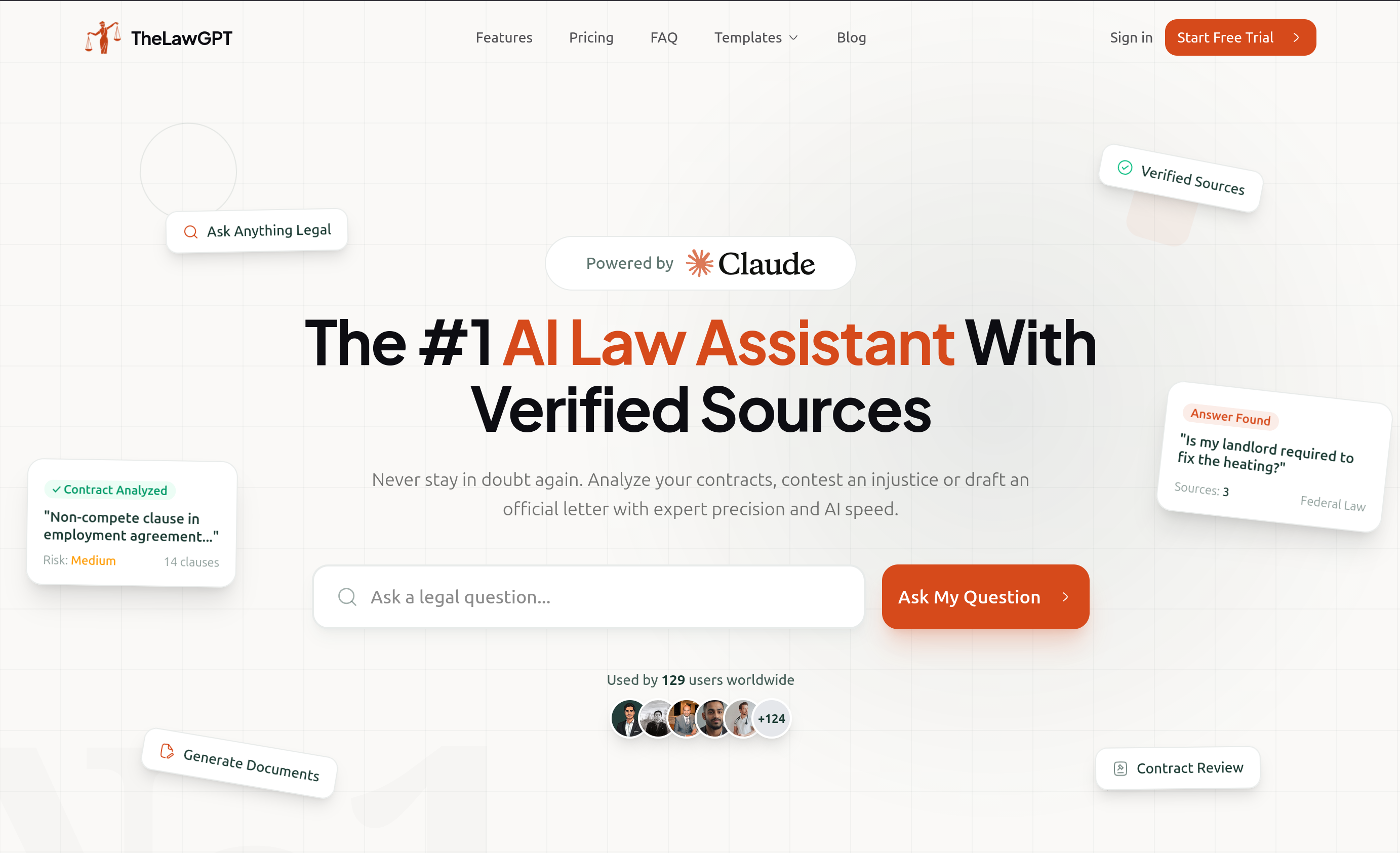
TheLawGPT is a legal AI assistant built around a single non-negotiable policy: it will not give you an answer it cannot cite.
Every response links to the actual statute, court decision, or legal article it pulled the answer from. Clickable. Verifiable. Not a summary of something the model vaguely remembers from training data.
It handles three core tasks:
- Legal Q&A: Ask a legal question in plain language and get a jurisdiction-specific answer grounded in real legal sources.
- Contract analysis: Upload a contract and get a clause-by-clause risk review, flagging unfair or unusual terms.
- Document generation: Create administrative letters, templates, and legal documents.
The tool covers seven jurisdictions and supports PDF, DOCX, and TXT uploads. It is powered by Claude AI, and your conversations are never used to train the model.
Key Features Breakdown
Contract Analysis
This is where TheLawGPT earns its keep for SME owners and business professionals. Upload a contract and it reviews it clause by clause, flagging terms that carry risk, impose asymmetric obligations, or deviate from standard practice.
You do not need to know contract law to use it. You need to know how to upload a PDF. The tool tells you what to watch out for, in plain language, before you sign.
Legal Q&A with Verified Sources
Ask "Is this non-compete enforceable in California?" and you get an answer tied to the California Business and Professions Code, not a generic paragraph about non-compete law in general.
Every source links out. You can read the original statute yourself. This matters not just for accuracy, but for trust. You are not taking the AI's word for it. You are reading the law it points you to.
Document Generation
The Pro and Business plans include document generation, which lets you create legal letters, notices, and templates without starting from scratch. For small firms and solo practitioners handling repetitive administrative work, this cuts hours out of the week.
Who Is TheLawGPT For?
TheLawGPT is not just for lawyers. The pricing and design reflect a broader audience.
Lawyers and law students use it to accelerate research and verify arguments before drafting. The multi-jurisdiction support makes it useful for firms handling cross-border matters.
SME owners and business leaders are arguably the most underserved audience in legal tech. Most legal AI tools are priced for law firms. TheLawGPT's free tier and $9.99 starter plan make source-verified contract review accessible to a business owner who cannot afford a lawyer for every supplier agreement.
Individuals dealing with employment contracts, landlord disputes, or consumer rights questions can get verified, plain-language answers without paying $300 for a one-hour consultation.
Privacy note: Conversations are never used to train the model, and the platform uses enterprise-grade encryption. If you are uploading sensitive documents, that matters.
TheLawGPT vs. Other Legal AI Tools
Here's how TheLawGPT compares to the main alternatives:
| Tool | Source Verification | Free Tier | Hallucination Policy | Jurisdictions |
|---|---|---|---|---|
| TheLawGPT | Yes, with clickable links | Yes (3 queries) | Zero-hallucination policy | 7 |
| Lexis+ AI | Partial | No | 17% error rate (Stanford) | US-focused |
| Harvey AI | No | No (enterprise only) | No stated policy | US-focused |
| ChatGPT | No | Yes | Frequently fabricates citations | General |
The comparison is not close on the dimension that matters most for legal work: can you trust the source?
Lexis+ AI and Westlaw are powerful research platforms with decades of data behind them, but their AI layers still hallucinate at rates that have triggered court sanctions. Harvey is built for large firms with enterprise budgets. ChatGPT is the tool that started the sanctions epidemic.
TheLawGPT trades breadth of features for depth of reliability. For most use cases, that is the right trade.
Pricing: What You Actually Get for Free
The free tier is genuinely usable: three legal Q&A questions and basic document review. Enough to try the source-verification feature before committing.
| Plan | Price | What You Get |
|---|---|---|
| Free | $0 | 3 Q&A questions, basic document review |
| Starter | $9.99/month | Unlimited Q&A, 5 contract reviews, conversation history |
| Pro | $24.99/month | 15 contract reviews, 10 document generations/month |
| Business | $49.99/month | Unlimited reviews, 30 generations, bulk upload, web search |
| Custom | Contact | Dedicated enterprise support |
For individual use, the Starter plan at $9.99 is the clear entry point. For a small firm handling regular contract work, the Pro plan covers the volume. The Business plan adds bulk upload, which matters for due diligence workflows.
Final Verdict
The legal AI category has a real problem, and it is not capability. It is trust. When an AI tool gives you a confident legal answer backed by a case that does not exist, you are not protected. You are exposed.
TheLawGPT's zero-hallucination policy is not a marketing claim. It is a structural constraint: the tool is built to refuse rather than fabricate. For anyone using AI to make or inform legal decisions, that is not a nice-to-have. It is the baseline requirement every other tool should be held to.
If you have a contract to review, a legal question you need a real answer to, or you are tired of paying for consultations on basic matters, start with the free tier.
Try TheLawGPT for free at thelawgpt.com
Sources:
- Jones Walker LLP: Ten AI Predictions for 2026 — $100K+ sanction data, hallucination governance trends
- Briefpoint: 5 Best AI Legal Research Tools 2026 — Stanford error rate data for Lexis+ AI (17%) and Westlaw (34%)
- Clio Legal Trends 2025 — 79% of legal professionals using AI
- Bloomberg Law 2026: Key Legal AI Trends — Market maturity signal
- TheLawGPT — Product, pricing, and feature claims